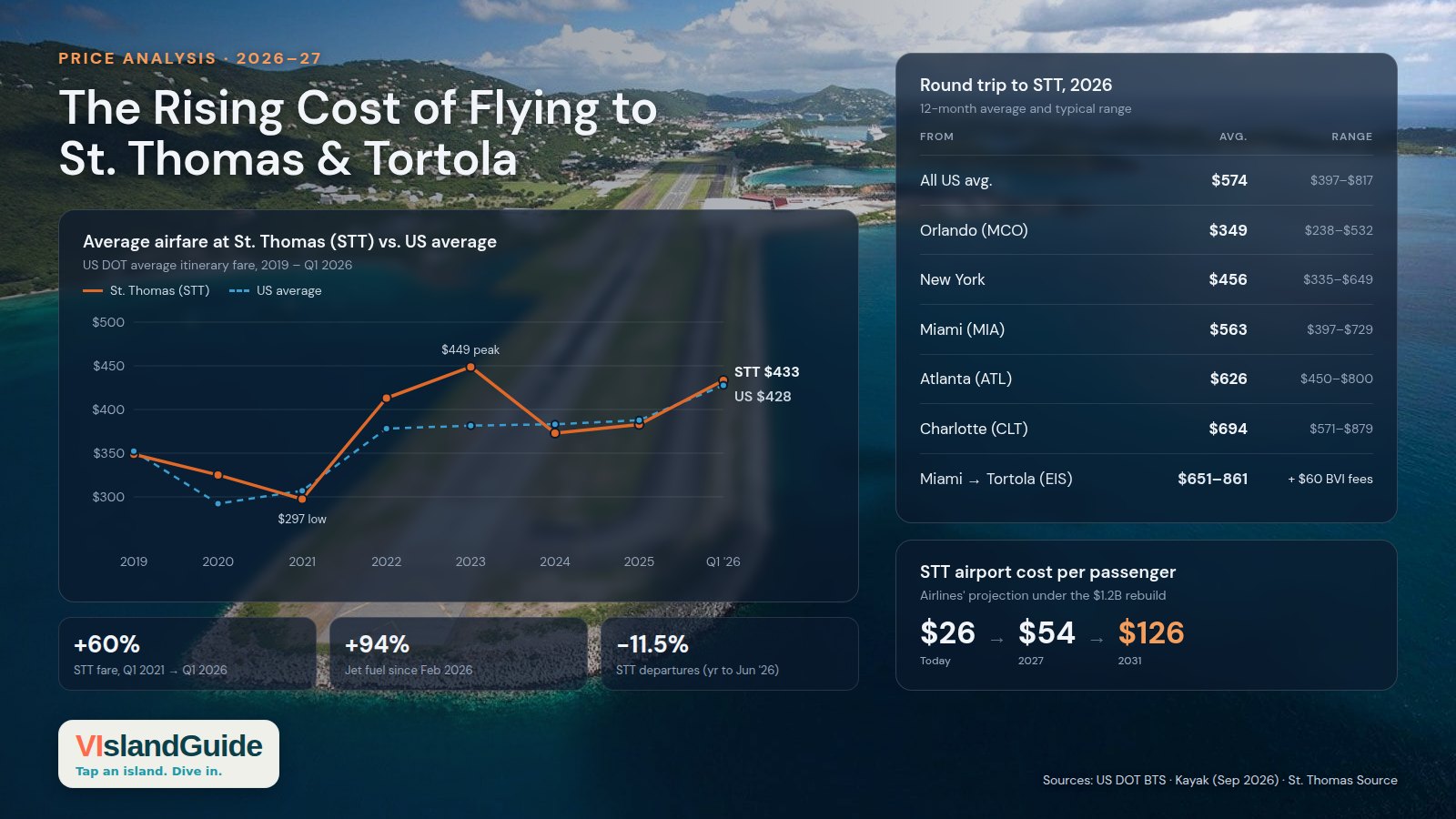
- The average fare at St. Thomas (STT) was $433 in Q1 2026, up 60% on Q1 2021 ($271).
- A typical mainland round trip to STT now averages about $574 (Kayak, September 2026).
- Since Q1 2026, three things have pushed prices up: Spirit's shutdown (May 2026), jet fuel nearly doubling since February, and 11% fewer departures from STT.
- Next: a proposed $1.2 billion airport redevelopment would raise what airlines pay per STT passenger from about $26 to $54 in 2027 and about $126 by 2031, by the airlines' count. They say it will go on your fare.
- Tortola (EIS) is pricier still: about $650–$860 round trip from Miami, plus $60 in BVI charges.
A trip to the Virgin Islands has always started with a flight that costs more than it feels like it should. But the last five years have been unusually volatile, and 2026 has stacked several price pressures on top of each other. We pulled five years of US Department of Transportation fare data, current fare-tracker averages, public testimony from the Virgin Islands Port Authority and the airlines, and the BVI's published fees, to answer one question: how much more does it cost to fly here now, and why?
St. Thomas airfare, 2019–2026: the federal numbers
The Bureau of Transportation Statistics (BTS) publishes an average fare for every US airport, including STT, every quarter. It is the most reliable long-run series there is. Here is St. Thomas against the national average:
| Period | STT avg. fare | US avg. fare | STT vs. US |
|---|---|---|---|
| 2019 | $348.73 | $352.27 | −1% |
| 2020 | $325.07 | $292.26 | +11% |
| 2021 | $297.39 | $306.97 | −3% |
| 2022 | $413.03 | $378.12 | +9% |
| 2023 | $448.71 | $381.53 | +18% |
| 2024 | $373.06 | $383.15 | −3% |
| 2025 | $382.82 | $387.74 | −1% |
| Q1 2026 | $433.30 | $427.69 | +1% |
Source: BTS Average Domestic Airline Itinerary Fares, by origin airport. Covers itineraries starting at STT (a 10% ticket sample; fares under $50 excluded). Q2 2026 has not been published as of September 25, 2026.
Three phases stand out:
- 2021: the floor. Pandemic-era demand pushed STT's fare down to $271 in Q1 2021, the lowest point in the series.
- 2022–2023: the boom. The USVI was one of the few passport-free "international-feeling" trips for Americans. STT fares rose 51% from 2021 to 2023, more than double the national increase (24%). The peak was Q2 2023 at $483, when STT ran 23% above the national average.
- 2024–2025: the cool-down. New capacity and competition, with Spirit still flying from Fort Lauderdale and Orlando, brought STT back below the national average. The Q3 2024 average was $342.
Q1 2026 started climbing again: $433, up 60% on Q1 2021. In inflation-adjusted terms that is still slightly below 2019 ($447 in 2026 dollars), which is worth remembering. But Q1 2026 was measured before Spirit shut down, and it includes only one month of the jet fuel spike. Everything that happened next is not in the federal numbers yet.
What a round trip costs right now, by city
Fare trackers show what travelers are actually being quoted. These are Kayak's rolling 12-month round-trip averages to STT, read on September 25, 2026:
| From | Avg. round trip | Typical range | Cheapest month | Priciest month |
|---|---|---|---|---|
| All US | $574 | $397–$817 | Jan ($488) | Jun ($720) |
| Orlando (MCO) | $349 | $238–$532 | Mar ($282) | Aug ($510) |
| Boston (BOS) | $452 | $325–$647 | Mar ($365) | Jun ($617) |
| New York (all) | $456 | $335–$649 | May ($349) | Dec ($557) |
| Newark (EWR) | $481 | $335–$663 | Sep ($375) | Jul ($688) |
| Baltimore (BWI) | $547 | $373–$767 | Mar ($411) | Jun ($945) |
| Miami (MIA) | $563 | $397–$729 | Apr ($311) | Jul ($691) |
| Atlanta (ATL) | $626 | $450–$800 | Apr ($493) | Jun ($823) |
| Charlotte (CLT) | $694 | $571–$879 | Feb ($550) | Nov ($834) |
Kayak 12-month averages are indicative. The window still includes Spirit's last months of low fares from Orlando and Fort Lauderdale, so the Florida averages in particular are likely to drift up as it rolls forward.
Spirit Airlines: what the Virgin Islands lost
Spirit flew to St. Thomas for about 20 years and was the only nonstop airline from both Fort Lauderdale and Orlando until Southwest arrived in February 2026. As recently as December 2025 it was selling $119 one-way anniversary fares, taxes included, for winter travel. It stopped flying on May 2, 2026. (Full story: what Spirit's shutdown means for STT.)
The scale of the loss, from BTS data and testimony to the VI Legislature:
- Market share: Spirit carried 13.9% of STT passengers (about 225,000) in the year to May 2025, and 9.7% (about 158,000) in the year to June 2026.
- Cancelled capacity: 646 scheduled USVI flights for May–December 2026 (565 of them at STT), 133,889 seats, and an estimated 99,128 visitor arrivals, according to tourism and Port Authority officials.
- Fort Lauderdale traffic to STT had already fallen from 64,600 to 42,200 passengers in the year to June 2026 as Spirit shrank.
Airlines rarely lower fares when a low-cost competitor leaves. Southwest, which now flies daily from Orlando, quoted about $466 round trip from MCO at launch. Spirit's $119 one-way anniversary fare worked out to $238 round trip. The Port Authority has said on the record that no airline can replicate Spirit's combination of price, frequency, and route choice.
What we can't tell you yet: exactly how much STT fares moved after May. The first federal quarter to include post-Spirit travel (Q2 2026) has not been published. We will update this analysis when it is.
Why 2026 fares are rising: fuel, fewer flights, and less competition
Jet fuel nearly doubled
US Gulf Coast jet fuel averaged $1.86 a gallon in 2021 and $2.26 in February 2026. After the Iran war began in late February, it jumped to $3.70 in March and $3.93 in April, and it has averaged $4.38 so far in September 2026 (peaking at $4.71 on September 15). Fuel is an airline's largest variable cost, and on a 3–4 hour over-water flight it is a big share of the fare.
US airfares are up 23% in a year
The Bureau of Labor Statistics' airline fare index was 23.4% higher in August 2026 than a year earlier and 45.5% higher than in August 2021. That is the whole country, not the Caribbean, but it sets the direction every STT fare is moving in.
Fewer flights, fuller planes
Scheduled departures from STT fell 11.5% in the year to June 2026 (19,326 to 17,112), while the number of passengers boarding stayed flat at about 814,000. Fewer seats chasing the same demand is exactly the condition in which airlines raise prices. The Port Authority told the Legislature that losing Silver Airways, Frontier and Spirit drove departures down 8% and arrivals down 12% through June 2026. Airlines including Southwest and Delta have also trimmed 2026 capacity growth because of fuel.
There are some bright spots
- Southwest started daily Orlando and Baltimore/Washington service in February 2026.
- Breeze Airways launches Tampa–STT on December 16, 2026, twice weekly from $149 one way (details).
- Boston traffic to STT more than doubled (16,800 to 35,200 passengers) in the year to June 2026.
New competition is the one thing that reliably pushes fares down on a route. It is not enough to offset fuel and Spirit's exit, but it helps specific cities.
See how busy STT is on your travel day
Every departure from St. Thomas, the passengers flying out, and the Customs + TSA wait by half hour, on the VIslandGuide flights tool.
STT Flights Dashboard →The $1.2 billion airport plan, and who pays for it
The next pressure is not here yet, and it may be the biggest. The Virgin Islands Port Authority (VIPA) chose a private partner, SkyCity VI (Aecon, Tikehau Star Infra, local builders J. Benton/Consigli, and operator Avports), in March 2024 to redevelop both USVI airports under a 40-year public-private partnership.
What would be built
- A new two-story terminal at Cyril E. King (STT) with 9 jet bridges. VIPA says the current terminal was built for about a third of today's passengers.
- A renovated terminal at Henry E. Rohlsen (STX) with 3 jet bridges.
- New baggage systems, enclosed air-conditioned check-in, reworked CBP/TSA processing, and seismic and hurricane resilience upgrades.
- Cost: about $1.2 billion all-in with financing, about $690 million of it construction. STT would be finished around 2031; STX takes about 18 months.
Separate from the P3: the $27 million runway rehab under way at STT since April 2026 (overnight closures through year-end) and a new ~$34.5 million airport fire station are funded mostly by FAA grants.
How the airlines would pay
This is not a new passenger tax. It would be paid through the rates and charges airlines pay the airport: landing fees, terminal rent, and per-passenger charges for counters, gates, baggage and international facilities. SkyCity's proposed tariff would recover about $67 million of operating costs in its first 11 months from November 1, 2026, with construction debt added as the new facilities open. The numbers in the published proposal:
| Charge | Proposed FY2027 rate |
|---|---|
| Landing fee (per 1,000 lb of aircraft weight) | $10.40, up from $3.83 (+172%) |
| Joint-use charge (per passenger) | $14.04 |
| Baggage charge (per passenger) | $9.02 |
| Holdroom charge (per passenger) | $5.15 |
| International facilities (per international passenger) | $45.62 |
The figure that matters most is cost per enplanement (CPE): everything an airline pays the airport, divided by departing passengers. This is the airlines' own projection of how it changes:
| Year | STT cost per departing passenger | Increase vs. today |
|---|---|---|
| Today | ~$26 | — |
| 2027 | ~$54 | +$28 (about 2×) |
| 2031 | ~$126 | +$100 (about 5×) |
| 2031 if traffic falls 10% | ~$156 | +$130 (6×) |
Source: airline and SkyCity figures reported by the St. Thomas Source (Aug 20 & 23, 2026). SkyCity has disputed parts of the airlines' math and has cited lower figures ($23–25 at the November 2026 step, $72–73 after modernization); it was not clear whether the $72–73 was a total or an increase.
For comparison, the airlines put San Juan at $11.41, Miami at $29 and New York LaGuardia at $41.20. At $126, STT would be one of the most expensive airports in the US system per passenger, for an airport a fraction of their size.
"We will absolutely be passing those costs on to you"
The airlines have been unusually blunt. At a July 2026 public hearing on St. Thomas, Lorin Carr of American Airlines, who chairs the airlines' airport committee, told residents: "We will absolutely be passing those costs on to you all." When VIPA said the tariff is "not a tax on passengers," Carr replied: "That is technically correct. But if you think costs don't get passed on to you, you are naive."
The objecting group includes American, Delta, United, JetBlue, Southwest, Sun Country and Cape Air, backed by the industry group Airlines for America. They have said they will not sign lease or rates agreements under the P3. They warn of a "death spiral": higher airport costs lead to fewer flights, which spreads the fixed costs over fewer passengers, which raises costs again. They point to Bermuda's airport P3 as an example. Cape Air, which runs many of the small inter-island flights, put it plainly: "I don't want them to say the airport is pretty, but it's not affordable."
The airlines offered an alternative: a smaller plan with about $390 million of capital (about $785 million all-in), and they offered to pay the roughly $40 million fee to exit the SkyCity deal. Governor Albert Bryan Jr. has said the territory is "moving forward with our plan," and VIPA and SkyCity argue that airport fees are a small share of total trip cost.
What it could mean for your ticket
If the airlines pass the increase straight through, each trip includes one departure from STT. Applied to today's $574 average round trip, and before any change in fuel prices or inflation, the illustrative math looks like this:
| Scenario | Added per traveler | Avg. round trip | Family of four |
|---|---|---|---|
| Today | — | $574 | $2,296 |
| 2027 tariff | +$28 | ~$602 (+5%) | +$112 |
| 2031, new terminal open | +$100 | ~$674 (+17%) | +$400 |
| 2031, traffic down 10% | +$130 | ~$704 (+23%) | +$520 |
Our arithmetic on the airlines' CPE projections, assuming full pass-through and nothing else changing. Airlines price by demand, not cost, so real fares could move by more or less than this. The bigger risk the airlines describe is not the fee itself but routes cut because the airport becomes too expensive to serve.
Status as of September 25, 2026: no signed SkyCity agreement and no adopted tariff has been reported. The original target for SkyCity to take over operations was November 1, 2026; VIPA now says it aims to finish negotiations before the end of 2026.
Flying to Tortola (EIS): the premium option gets pricier
Flying straight into the British Virgin Islands has always cost more than flying into St. Thomas and taking the ferry. The changes since 2023:
| Airline | Route | Status |
|---|---|---|
| American Eagle | Miami–EIS | Launched June 2023; up to 6 daily from Oct 5, 2026, its largest BVI schedule yet |
| Silver Airways / Seaborne | San Juan–EIS | Stopped flying June 11, 2025 after bankruptcy |
| Cape Air | San Juan / St. Thomas–EIS | Took over much of Silver's flying |
| interCaribbean | San Juan–EIS + Caribbean | Flying since 2016; took over Silver's San Juan route alongside Cape Air |
| Tradewind | San Juan–EIS | Seasonal daily service Dec 10, 2026 – Apr 12, 2027 |
| LIAT 2020 / Winair / Caribbean Airlines | Eastern Caribbean | Regional links launched 2024–26 (check current schedules) |
What EIS costs
- Miami–Tortola on American: about $861 round trip (January) and $651 (mid-February) in the 2024–25 winter; about $786 (July) and $686 (mid-December) in 2026 samples.
- Cape Air: from about $185 one way San Juan–EIS and $259 one way St. Thomas–EIS on its booking site in September 2026.
- BVI charges on every visitor: a $50 air departure charge ($15 tax + $5 security + $30 airport development fee, usually built into the fare) and a $10 environmental and tourism levy on arrival.
There is no BVI equivalent of the US federal fare series, and American only started flying to EIS in 2023, so a clean five-year fare comparison for Tortola doesn't exist. What the numbers do show is that a Miami–Tortola nonstop costs roughly $100–$300 more per person than Miami–St. Thomas, before the BVI's $60 in charges. The collapse of Silver Airways also removed one of the few alternatives on the San Juan–Tortola route.
Tortola's runway extension
The BVI is extending its own airport. Cabinet approved a business case for a 7,000-foot runway (from about 4,650 ft) in October 2025. The first phase out to tender is a 787-foot extension, with bids due August 31, 2026. No project cost has been published, and the Airports Authority intends to ask the Social Security Board for financing. According to reporting on the government's business case, it would be funded partly through a "modest increase in passenger fees" under a P3. That is less dramatic than the USVI plan, but it points the same way. A longer runway is also what would let bigger jets fly nonstop from more US cities, which could bring EIS fares down over time.
Taxes on a USVI ticket
Part of every STT fare is government charges. Because of how federal tax law treats travel to the USVI, a mainland–STT ticket carries the international arrival/departure tax instead of the domestic 7.5% ticket tax:
| Charge | Amount (2026) |
|---|---|
| US international arrival/departure tax | $23.40 per person, each way |
| September 11 security fee | $5.60 per one-way trip |
| Passenger facility charge (STT) | $4.50 (the federal maximum, already charged) |
| Domestic 7.5% ticket tax | Not charged on mainland–USVI trips |
The $4.50 PFC is already at the federal cap, which is one reason the airport redevelopment is being funded through airline charges rather than a direct passenger fee.
How to keep your Virgin Islands airfare down in 2026–27
- Pick your gateway. Orlando (Southwest, ~$349 avg.), Boston and New York are consistently the cheapest; Charlotte and Atlanta the priciest. A cheap positioning flight to MCO or JFK can beat a connection from home.
- Watch Tampa. Breeze's TPA–STT launch in December 2026 starts from $149 one way; introductory fares on a new route are often the lowest it will see.
- Avoid June and December. They are the most expensive months to fly to STT from most cities. January, March–May and September are usually cheaper.
- Going to the BVI? Price both ways. Flying into STT and taking the ferry to Tortola (see the ferry schedule) is often cheaper than a Miami–EIS nonstop, even after the ferry fare and BVI fees. The nonstop saves hours; decide what that is worth.
- Book winter 2026–27 early. Fuel costs are already in fares, Spirit's seats are gone, and the airport tariff, if adopted, adds to that from 2027. Waiting is unlikely to be rewarded.
- Set fare alerts on two or three origins, not one. The spread between gateways is often bigger than the swing on any single route.
The bottom line
Flying to St. Thomas is not dramatically more expensive than in 2019 in inflation-adjusted terms, yet. It is much more expensive than 2021, and every force acting on fares in 2026 points up: the low-cost carrier is gone, fuel has nearly doubled, departures are down, and national airfares are rising 23% a year. The proposed airport rebuild would then add a cost the airlines have said, on the record, they will pass to passengers, and could double the airport's per-passenger cost in 2027 and increase it five-fold by 2031. Travelers to Tortola start from a higher base and pay the BVI's charges on top.
A modern airport is overdue. The open question for 2026–27 is who pays for it, and how much of the bill ends up on the ticket.
Frequently asked questions
How much does it cost to fly to St. Thomas in 2026?
The federal average fare for trips starting at St. Thomas (STT) was $433.30 in Q1 2026, the latest quarter the DOT has published. Kayak's 12-month average for a round trip from the US mainland to STT was $574 as of September 2026, with a typical range of $397–$817. Orlando ($349) and New York ($456) are among the cheapest gateways; Charlotte ($694) and Atlanta ($626) are among the most expensive.
Did flights to St. Thomas get more expensive after Spirit Airlines shut down?
Spirit stopped flying on May 2, 2026. Federal fare data for the months after Spirit's exit has not been published yet (the DOT's Q2 2026 figures are still pending), so no one can yet put a precise number on it. What is known: Spirit carried about 1 in 10 STT passengers, it was the only nonstop from Fort Lauderdale, it sold $119 one-way anniversary fares as recently as early 2026, and the Port Authority says no airline can replicate its mix of price and routes. At the same time, US airfares overall rose 23.4% year over year by August 2026.
Will the new St. Thomas airport make flights more expensive?
Probably, if the plan goes ahead as proposed. The $1.2 billion SkyCity VI redevelopment would be paid for through the fees airlines pay the airport. The airlines estimate that cost per departing passenger would rise from about $26 today to about $54 in 2027 and about $126 by 2031. American Airlines' Lorin Carr told a public hearing: "We will absolutely be passing those costs on to you all." The deal and the tariff were not final as of September 2026.
How much does it cost to fly to Tortola (EIS)?
American Airlines' Miami–Tortola nonstop ran about $686–$786 round trip in 2026 Google Flights samples, and $651–$861 in the 2024–25 winter. Cape Air's regional hops start from about $185 one way from San Juan and $259 one way from St. Thomas. The BVI adds a $50 air departure charge (usually built into the ticket) and a $10 environmental and tourism levy on arrival.
What is the cheapest month to fly to St. Thomas?
It depends on where you fly from. Across all US origins, Kayak's cheapest month to St. Thomas is January ($488 average round trip) and the most expensive are June ($720) and December ($676). From Miami the cheapest month is April; from Orlando, Baltimore and Boston it is March; from New York it is May.
Plan your arrival day
Live STT departures and arrivals, passengers by hour, and the Customs + TSA wait for any day in the next week.
STT Flights Dashboard →Sources & methodology
- US DOT, Bureau of Transportation Statistics: Average Domestic Airline Itinerary Fares (STT and national, 2019–Q1 2026) and STT airport carrier and route data (to June 2026).
- Bureau of Labor Statistics, CPI airline fares (CUUR0000SETG01), via FRED; US Gulf Coast jet fuel spot price (DJFUELUSGULF), via FRED.
- Kayak route pages, St. Thomas (STT), 12-month round-trip averages, read September 25, 2026.
- St. Thomas Source: airlines warn fees could raise airfares (Jul 28, 2026); St. Thomas hearing (Jul 30); airlines' $785M alternative (Aug 20); two airport plans compared (Aug 23); Spirit shutdown testimony (Aug 10).
- VI Consortium: VIPA and SkyCity outline the airports and fee structure (Jul 28, 2026); fuel shock and airfares (Sep 17, 2026).
- WTJX Newsfeed, VIPA's proposed tariff increases (Aug 14, 2026); VI Legislature, FY2027 budget hearing (Aug 17, 2026).
- Caribbean Journal on American Airlines' Tortola service (Jan 2025, Jul 2026), Southwest's STT launch (Feb 2026) and Breeze (Jul 2026); BVI News on Silver's exit and the runway tender.
- BVI Airports Authority, departure charges; Government of the Virgin Islands, environmental levy; IRS Publication 510 (2026 air transportation taxes).